



Executive Summary
-
Advances in 3D printing, online weapon blueprints, and modular gun parts are lowering the barriers to building Privately Manufactured Firearms (PMFs), commonly called ghost guns. This is reducing reliance on traceable firearms acquisition channels and weakening conventional threat-detection indicators.
-
Improving ghost gun reliability and concealability are increasing risks to executives, public-facing personnel, corporate sites, and high-traffic business environments. This raises exposure to workplace violence, executive targeting, event disruption, and related financial and reputational consequences.
-
Fragmented regulation and the wider availability of dual-use inputs are also increasing compliance, legal, and operational exposure for businesses, particularly across manufacturing, retail, logistics, digital services, and other high-visibility sectors.
-
Consult intel@max-security.com for custom threat monitoring services to ensure early identification of ideological triggers, local crime assessments, and other challenges, along with assistance in exposure assessments and other safety and security needs.
Introduction
Ghost guns, or Privately Manufactured Firearms (PMFs), are guns assembled outside licensed manufacturing and retail channels using partially completed gun parts, modular kits, and 3D-printed components. Unlike factory-made firearms, ghost guns may lack serial numbers or clear ownership records, making it harder for authorities to trace their origins after a security incident or enforce background-check requirements. Despite restrictions in many jurisdictions, commercially available tools, online weapon blueprints, and advances in consumer-grade 3D printing are lowering the technical and financial barriers to producing functional firearms outside regulated procurement channels.
In December 2024, UnitedHealthcare CEO Brian Thompson was killed in a targeted attack in New York, with authorities reportedly recovering a 3D-printed handgun and suppressor from the suspect. The incident has fueled broader concerns around the growing accessibility, reliability, and potential use of ghost guns in targeted violence globally. The case is one of the clearest recent examples of how privately manufactured weapons can intersect with corporate targeting. However, it is part of a wider trend in which homemade and 3D-printed firearms are appearing in political, extremist, and criminal incidents across multiple regions.
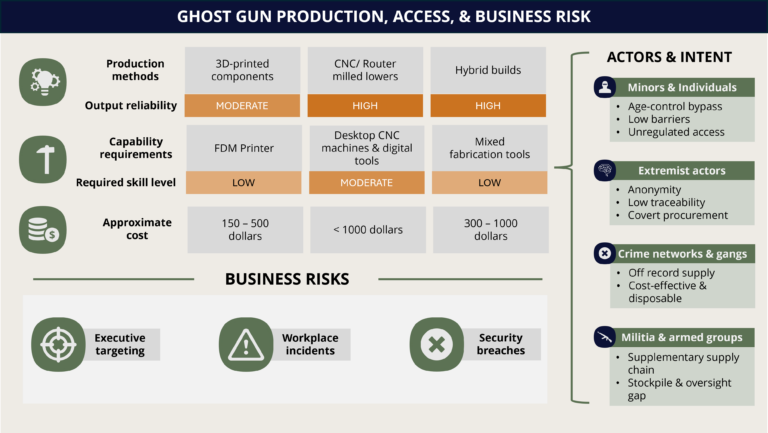
Easy access to production material, knowledge, improving technical sophistication boosts production of ghost guns outside traceable channels
Ghost guns are becoming more operationally effective as consumer-grade manufacturing technologies improve. Earlier constraints around fragility and failure rates for ghost gun usage are now being addressed through better materials, higher printing precision, and hybrid builds that combine 3D-printed components with commercially available metal parts. This has also enabled the production of accessories and conversion components, including 3D-printed suppressors, that can reduce acoustic and forensic signatures, as well as auto-conversion devices, commonly known as Glock switches or auto sears, which convert semi-automatic ghost guns to automatic fire. Collectively, these trends point to improving the functionality and lethality of ghost guns. Separately, the polymer frames common to ghost gun production contain less metal than conventional steel-framed firearms, reducing their detectability through standard metal-detection screening, improving the concealability of ghost guns as well.
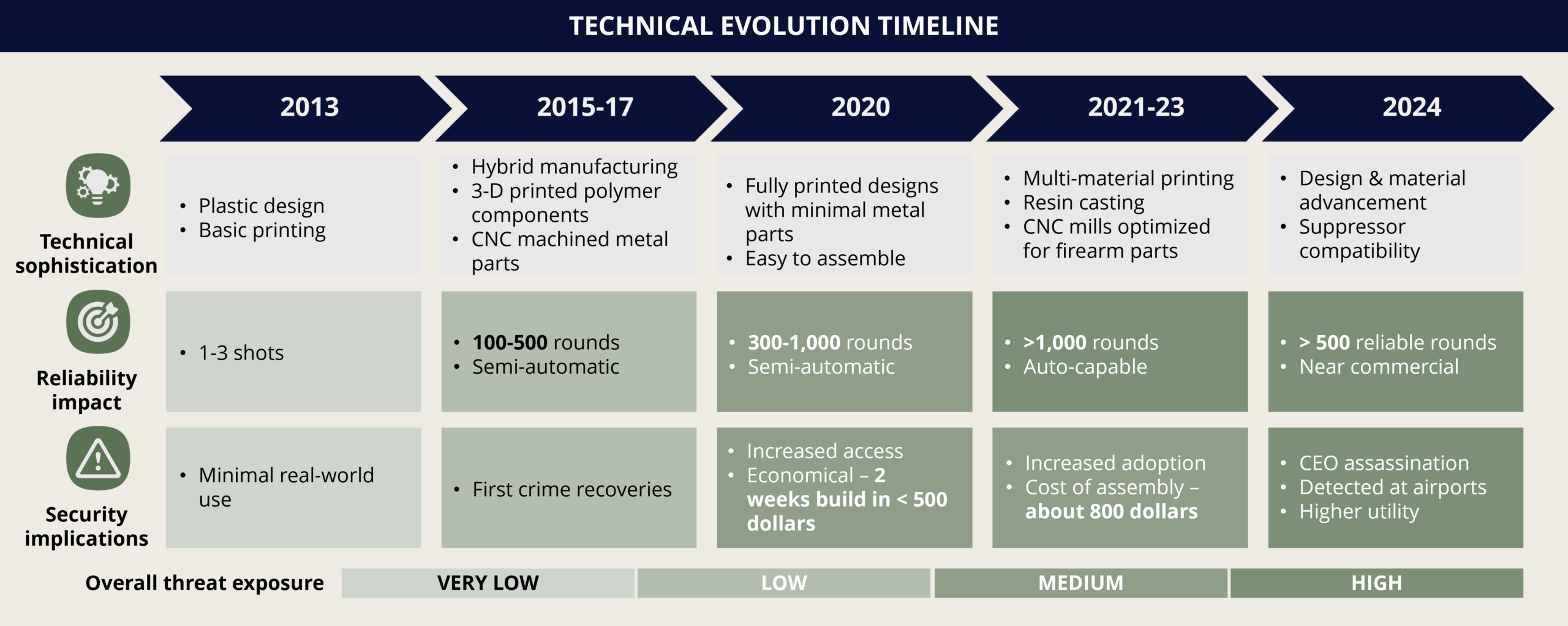
The low cost and accessibility of consumer-grade manufacturing technologies further support decentralized ghost gun production. A basic FDM printer capable of producing functional receiver components is widely available through consumer electronics retailers and online platforms for under 300 USD on average in Western countries. Once acquired, additional components can be procured at minimum marginal costs. Likewise, standardized design files, assembly workflows, and troubleshooting guidance are freely circulated through encrypted platforms, online forums, and social media communities. This enables individuals to manufacture ghost guns with limited technical expertise and minimal infrastructure requirements. Since 2024, multiple cases involving extremist and grievance-driven actors in the US and Europe have demonstrated how individuals can build ghost guns over weeks or months of preparation, without generating any procurement signals detectable by law enforcement. Between 2020 and 2025, the UK identified at least 11 terrorism-related cases involving attempts to manufacture or acquire 3D-printed weapons.
This comes as regulation of ghost gun production inputs is fragmented globally. Some jurisdictions, including the US, Singapore, and parts of Australia, have expanded controls over unfinished receivers and digital weapon blueprints. Elsewhere, including New Zealand and much of Europe, regulations remain more focused on finished weapons than on the wider ecosystem of components, software, tools, and instructions that enable production. Many components, including springs, polymers, metal tubing, and 3D printers, are legally available through commercial channels, with scrutiny often emerging only when purchase patterns clearly indicate weapons’ production intent and possibility.
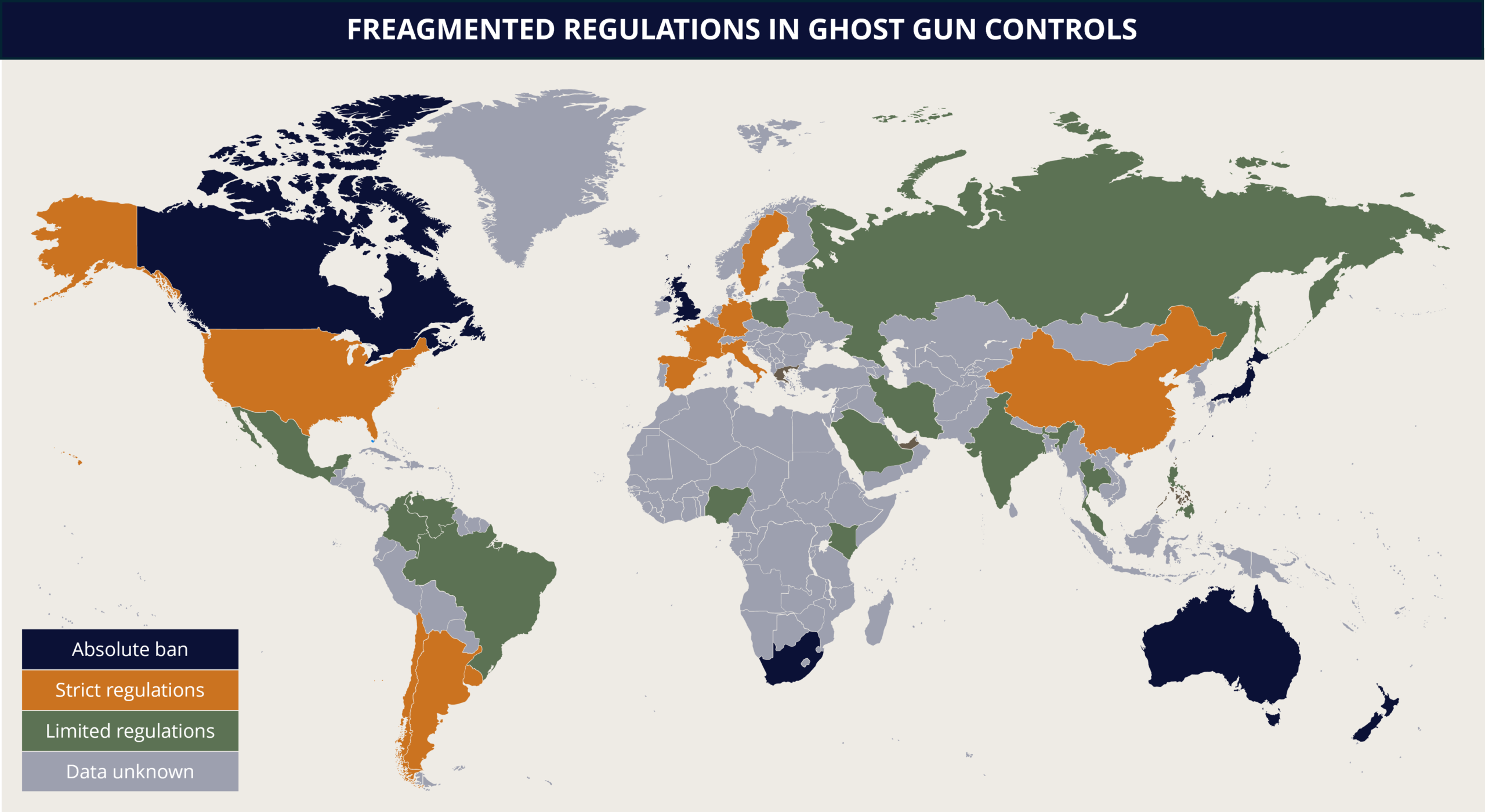
This uneven oversight allows firearm assembly while bypassing observable and traceable supply chain elements like dealings with a licensed manufacturer, a registered dealer, a background check, and a sales record. A motivated attacker can build a functional weapon at home using parts sourced from commercial retailers and instructions downloaded from the internet, without generating any signals that a security team could act on to identify them as an emerging threat actor. This can enable the establishment of small-scale illegal enterprises within lawful commercial ecosystems, as illustrated by a 2026 US case involving two brothers convicted for operating a ghost gun production business using printed frames and metal parts sourced through commercial marketplaces like eBay. Untraceable patterns of procuring materials for ghost gun production also make prominent and concrete public examples of ghost gun use limited, with the direct attribution of ghost gun use in various cases proving to be difficult.
This is capitalized upon by threat actors, including criminals, extremists, and grievance-driven individuals, expanding the adoption of ghost guns, with the threat actively impacting urban centers. US and Western European law enforcement seizure data show that unserialized firearms are increasingly present in urban crime environments. In the US, a 2025 Crime Gun Recovery report found that after a new 2022 Bureau of Alcohol, Tobacco, Firearms and Explosives (ATF) regulation, there was a decline in recoveries of Polymer80-style ghost guns, which are unserialized firearm frames that are 80 percent built with a machine, and the remaining parts are built manually by the user to make them functional. This decline happened because the new regulation required these Polymer80 frame kits to be serialized and processed with background checks. At the same time, recoveries of fully 3D-printed firearms, which are produced from scratch using a printer and freely available design files, and fall outside the same regulation, increased sharply across major US cities. This suggests that when one production route is regulated, demand shifts to another that remains uncontrolled.
The rise in ghost gun recoveries is not limited only to the US. Countries with strict conventional gun laws like France, Greece, Italy, and Spain have also reported growing ghost gun seizures since 2023. While these countries restrict conventional firearms, gaps in regulations covering 3D-printed weapons and weapon blueprints allow ghost gun production to continue, putting untraceable weapons into circulation. Similar intentions to avoid detection have also fueled ghost gun adoption even in countries with weaker conventional firearm regulatory enforcement, like Brazil and Pakistan. In April 2026, Toronto police arrested a suspect in connection with an alleged ghost gun manufacturing and trafficking operation, showcasing that ghost gun activity is now appearing in ordinary urban criminal investigations rather than only in high-profile cases. Similar trends from around the world showcase that ghost guns are no longer confined to isolated criminal markets but are becoming a broader and increasingly accessible security challenge across multiple regions and regulatory environments as threat actors capitalize on their growing efficiency and weak traceability.
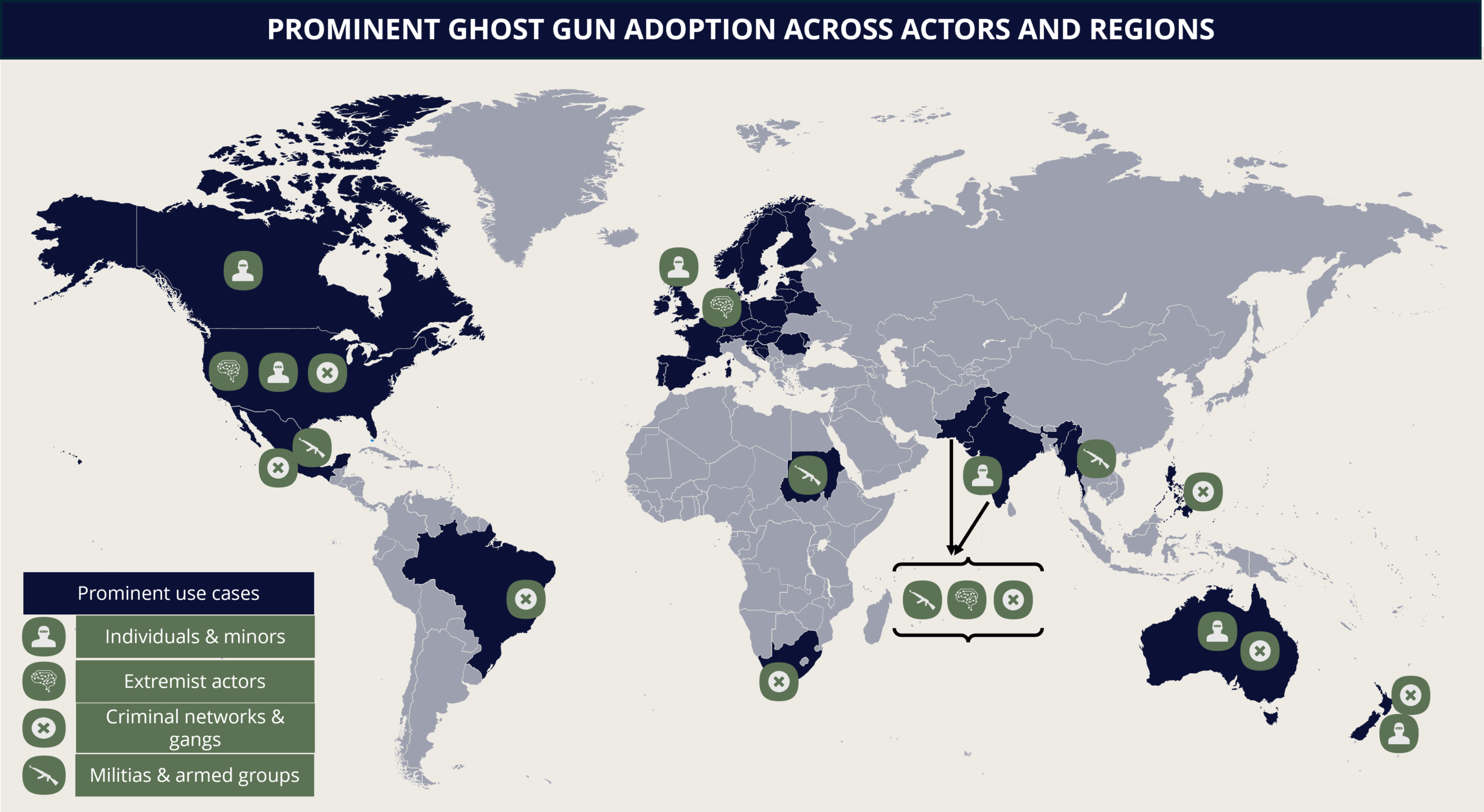
In more regulated settings, such as parts of Europe, the UK, Canada, and Australia, ghost guns are partially substituting for conventional illicit procurement of weapons. In higher-crime and conflict-affected environments, including parts of Latin America and Southeast Asia, ghost guns more often supplement existing weapons flows, providing an additional, harder-to-trace capability alongside illicit networks for conventional weapons acquisition. In Brazil, ghost gun production has moved beyond individual assembly into small clandestine workshops supplying criminal networks in major urban centers, representing the most advanced documented case of ghost gun production scaling into an organized supply model.
The growing accessibility of ghost guns is also increasingly intersecting with extremist mobilization and online radicalization ecosystems. The 2022 assassination of former Japanese Prime Minister Shinzo Abe using a weapon improvised from hardware-store materials, metal pipes, wood, and electrical tape, demonstrated that self-made firearms can defeat strict controls even in highly regulated environments. Subsequent cases include a far-right cell in Leeds in 2024, planning an attack with a 3D-printed gun, a Finnish accelerationist cell in 2023 that had already manufactured ghost guns and was targeting politicians, and a jihadist-linked plot disrupted in Antwerp in October 2025, indicating that the threat of ghost guns spans ideological categories. Together, these trends indicate that ghost guns are becoming increasingly accessible across a broad range of extremist and criminal threat environments.
FORECAST: Advancements in production capabilities, low marginal production costs, the self-sufficiency of local production ecosystems, and the persistence of regulatory gaps mean that supply-side disruption, historically the primary tool for reducing weapons availability, will become progressively less effective at constraining ghost gun access. Limiting the effectiveness of conventional monitoring and interdiction mechanisms will also likely enhance the adoption of ghost guns across criminal and extremist threat environments. Taken together, these trends suggest that ghost guns are likely to become more accessible, operationally reliable, and geographically widespread. This will likely in turn increase security and operational risks for businesses, government organizations, and ultra-high-net-worth individuals (UHNWI) associated with the persistent difficulty in tracing firearms and procurement patterns, particularly in relation to targeted violence and activism-driven attacks against executives and corporate assets.
Proliferation of ghost guns contributes to concerns about increased physical security, operational, compliance risks, associated costs for businesses
For businesses, the proliferation of ghost guns elevates an existing baseline of corporate targeting, particularly among firms exposed to political, ideological, criminal, or grievance-driven threats. This includes firms operating in sectors such as finance, technology, manufacturing, energy, healthcare, logistics, and projects associated with specific national interests or controversial government policies. Industry security reporting from 2026, while not specific to ghost guns, indicates that targeted incidents against corporate executives, particularly CEOs, reached record levels in 2025, with activism accounting for approximately 38 percent of incidents and criminal intent approximately 36 percent. The UnitedHealthcare CEO Brian Thompson’s case from 2024 illustrates this convergence. An ideologically motivated attacker, a target selected from a publicly scrutinized sector, and a weapon fabricated with no acquisition trail, showcasing how their lowering costs, alongside increasing reliability and availability, can enable hostile individuals or small networks to act on existing grievances against executives, corporate sites, and events.

Ghost guns also specifically elevate insider-threat risks because they remove the one external checkpoint, a regulated firearms purchase, that might otherwise surface in background checks and indicate intent before an incident. A global 2026 executive-targeting report indicated that approximately 18 percent of assailants had a direct workplace connection to the target. An employee, contractor, or vendor with legitimate facility access who builds a ghost gun off-site generates no background check flag, no purchase record, and no signal visible to HR or even active corporate security functions that may be monitoring internal employee behavior or screening for potential threat actors through coordination with law enforcement. As ghost guns remove the procurement signal that might otherwise flag such individuals, traditional early-warning indicators become less reliable.
FORECAST: Therefore, for businesses, the practical effect of ghost guns is a reduction in the upstream signals that corporate security functions depend on, not because businesses monitor firearms purchases directly, but because the broader threat intelligence ecosystem does. Law enforcement monitoring of trafficking networks, background checks that surface weapons-related criminal records, and protective intelligence services that track threat actor procurement all become less effective when there is no acquisition to monitor. As ghost gun use grows, businesses will increasingly need to replace these degraded external signals with behavioral monitoring, insider-threat programs, online activity tracking, and localized intelligence gathering, despite these inputs being less consistent, harder to validate, and more resource-intensive to maintain.
Ghost guns may also complicate screening and access-control environments, particularly where weapons components can be transported separately or where facilities rely on fast-moving screening systems calibrated primarily for conventional threats. Standard walk-through metal detectors, calibrated to minimize false positives from personal items, are not consistently effective against polymer-framed ghost guns with minimal metal content, which is particularly a documented limitation in aviation and protective-security assessments. A ghost gun built on a polymer frame with a metal barrel presents a materially different detection profile from a conventional all-steel firearm and may not trigger standard alert thresholds. Millimeter-wave imaging systems, which detect shape and mass density rather than metallic composition, are more effective against ghost guns, but remain unevenly deployed. This is likely to increase pressure for expanded screening procedures, tighter access controls, additional guard-force requirements, and more restrictive event-security measures across public-facing business environments.
These pressures are likely to increase operational disruption risks across transportation, aviation, logistics, and other high-throughput commercial environments. Airports, ports, rail hubs, cargo terminals, warehouses, hospitality venues, and large public events combine high footfall, complex access-control requirements, and limited tolerance for security failures. The ghost-gun-specific contribution to these disruption risks is not that incidents occur, since any firearm can trigger the same precautionary responses, but that the attribution difficulty specific to untraceable weapons extends the investigation timeline. When a weapon cannot be traced to a known source, security teams cannot quickly assess whether additional weapons are in play, whether a broader network is involved, or whether the threat is contained over a longer period, affecting future security planning. The uncertainty prolongs precautionary shutdowns and security reviews beyond what a conventional firearms incident would typically require. Therefore, even isolated incidents involving ghost guns may trigger prolonged secondary screening procedures, cargo delays, passenger disruption, evacuations, and wider supply chain impacts. Industries dependent on just-in-time logistics networks, including electronics, automotive manufacturing, pharmaceuticals, food distribution, and retail supply chains, may be particularly exposed to cascading operational disruption following security incidents at transportation nodes or logistics facilities.
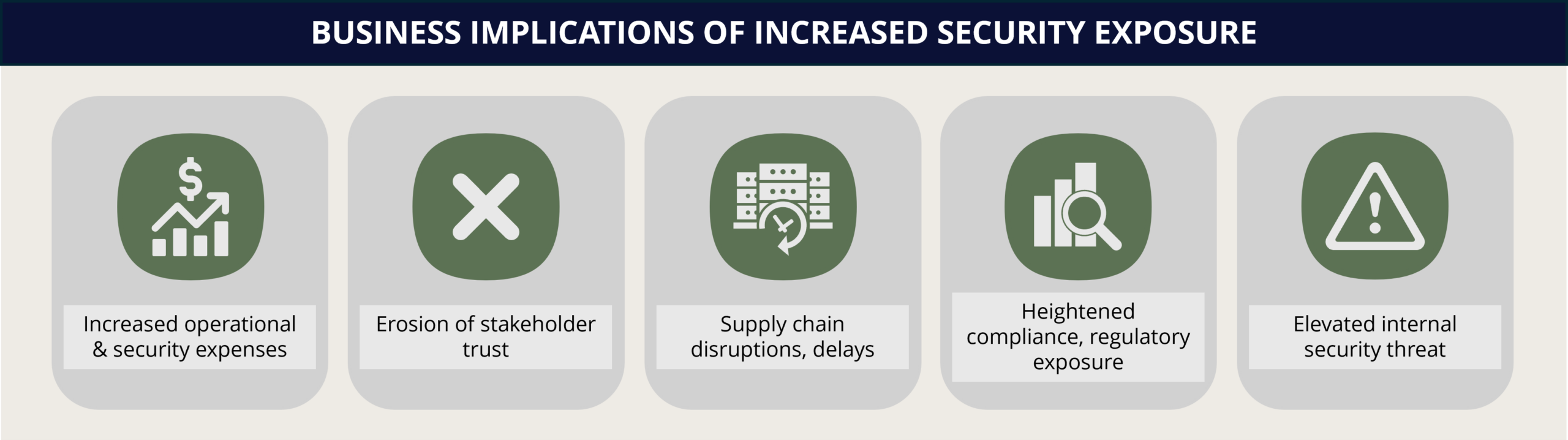
FORECAST: These pressures are likely to gradually increase security-related operating costs across multiple industries, linked to executive protection, as well as broader logistics. Reports indicate that Fortune 500 companies increased security spending by approximately 25 percent in early 2025, while more than one-third of S&P 500 companies expanded executive-security benefits and reduced leadership visibility following growing concerns around targeted violence. Businesses may increasingly relocate public events, limit executive exposure, strengthen facility security measures, and expand close-protection arrangements. Although these measures may improve deterrence and incident-response capability, they can also reduce operational efficiency, disrupt movement across high-traffic environments, and increase operating costs without proportionately improving predictive capability.
The decentralized ecosystem supporting ghost gun production is also creating growing compliance and liability concerns for companies that provide dual-use goods, services, or infrastructure. Manufacturers, online marketplaces, logistics firms, payment-service providers, and firms operating within additive-manufacturing ecosystems may increasingly face scrutiny where products or services are repeatedly linked to downstream weapons production. In March 2025, the Manhattan District Attorney wrote to Shenzhen Creality 3D Technology following the seizure of the company’s printers in multiple criminal ghost gun investigations, signaling growing scrutiny toward manufacturers whose products are associated with illicit firearm production. Liability exposure is also extending into digital enablement. In February, California initiated legal action against entities accused of facilitating 3D-printed ghost gun production through the distribution of digital firearm-manufacturing code, reflecting broader efforts to impose accountability across the wider production ecosystem.
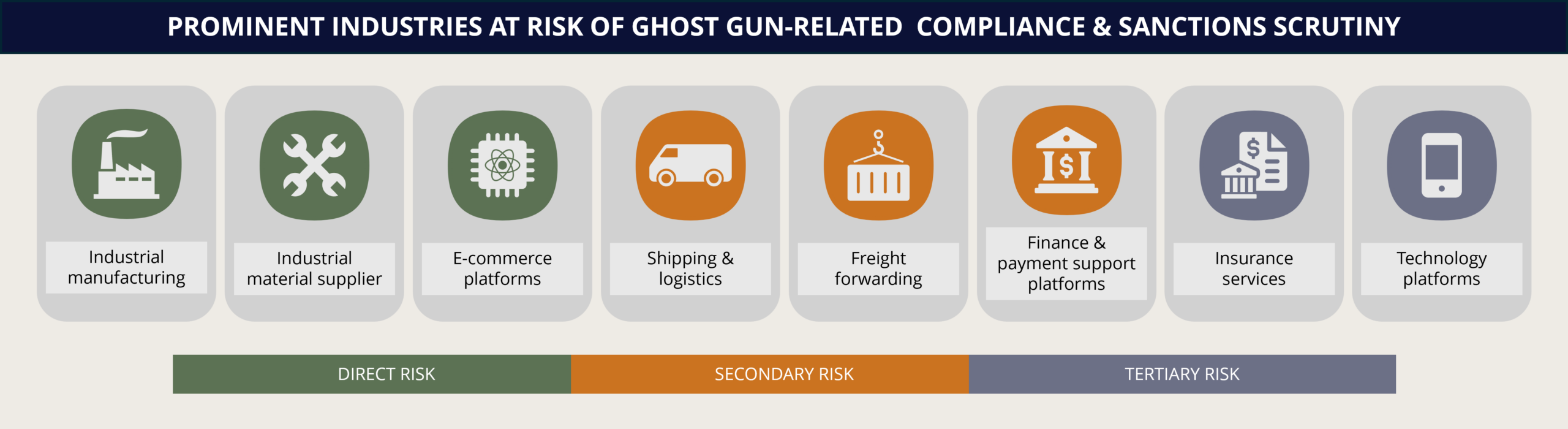
FORECAST: As governments continue expanding oversight of ghost gun production inputs and enabling technologies, businesses handling dual-use products and services are likely to face increasing pressure to strengthen customer due diligence, monitoring mechanisms, and supply-chain oversight. Companies operating across conflict-affected or sanctioned environments may also face elevated export-control and retrospective enforcement risks where products, software, or manufacturing inputs are diverted into illicit weapons ecosystems. Over time, this is likely to increase compliance costs, regulatory scrutiny, contractual loss, and reputational exposure across multiple industries.
Ghost gun proliferation may also come to create broader insurance and financial risk implications. Because incidents involving untraceable firearms can be more difficult to investigate and reconstruct, insurers may face greater uncertainty around liability assessments and claims attribution. Reduced predictability surrounding targeted violence and workplace-security incidents are also likely to affect underwriting models and insurer risk assessments, particularly in high-visibility sectors and public-facing operating environments.
FORECAST: Over time, businesses may face higher insurance premiums, stricter policy conditions, and greater insurer scrutiny of executive-protection arrangements, workplace-violence prevention programs, facility-access controls, and crisis-response capabilities. Organizations operating in sectors facing elevated targeting risks may therefore experience not only rising security expenditure, but also a growing proportion of financial risk transferred back onto firms through deductibles, exclusions, or self-insurance requirements.
Conclusion
Ghost guns represent more than an incremental increase in available weapons. They mark a structural shift in how armed threats are generated. The Thompson killing demonstrates what this looks like in practice: a premeditated attack on a named corporate executive, carried out with a 3D-printed weapon and suppressor that were fabricated without any acquisition trail, in a sector that had no prior indication of this specific threat vector. Because production can now occur at or near the point of use, without engaging the supply chain, transactional, or logistics nodes that conventional threat intelligence relies on, the risk environment is becoming progressively harder to anticipate using existing methods. The required adaptation is a corresponding structural shift from access-point screening as the primary control layer to intelligence-led threat assessment as the upstream layer, with perimeter measures as a secondary filter. For businesses, this means higher security costs, increased operational friction, and a greater likelihood that even localized events disrupt broader activities. Risk is less defined by isolated incidents and more by persistent exposure, requiring companies to prioritize continuity and response alongside prevention, because higher investment in physical security alone does not proportionately improve control, resilience, or predictability.
Recommendations
-
Consult intel@max-security.com for custom threat monitoring services to ensure early identification of ideological triggers, local crime assessments, and other challenges, along with assistance in exposure assessments and other safety and security needs.
Physical security
-
Consult intel@max-security.com for targeted assessments of executive protection and site security, covering residences, transit routes, public facing engagements, and perimeter vulnerabilities beyond primary entry point.
-
Businesses should set up frameworks to strengthen insider risk controls by tightening access management, contractor vetting, and monitoring, alongside the use of randomized screening and mobile detection units to reduce predictability in coverage.
Operational safeguards
-
Businesses should conduct scenario-based simulation exercises focused on localized security incidents at operational sites, focusing on shutdown protocols, evacuation, and phased restart timing. In addition, businesses should ensure response thresholds which limit unnecessary full-site shutdown while maintaining safety compliance.
-
Businesses should diversify sourcing arrangements, reassess just-in-time dependencies, and build inventory buffers for critical inputs where feasible, particularly for businesses where supply chains are closely associated to high-risk regions.
-
Businesses should assess insurance coverage and contractual terms for exposure to operational disruption and service delays arising from security incidents or heightened threat conditions, ensuring clarity on liability exclusions, and business interruption triggers.
Compliance risks
-
Businesses should conduct end-to-end mapping of exposure to dual-use components across supply chains, including distributors, third-party vendors, and cross border transactions.
-
Businesses should strengthen end-use verification processes, particularly for bulk orders or fragmented purchases of materials with potential misuse applications.
-
Businesses should integrate sanctions and export control screening with transactional monitoring to identify cumulative risk across seemingly compliant individual transactions.