


Exposure Risks for Executive and UHNW Travelers to the 2026 FIFA World Cup
- MAX Security
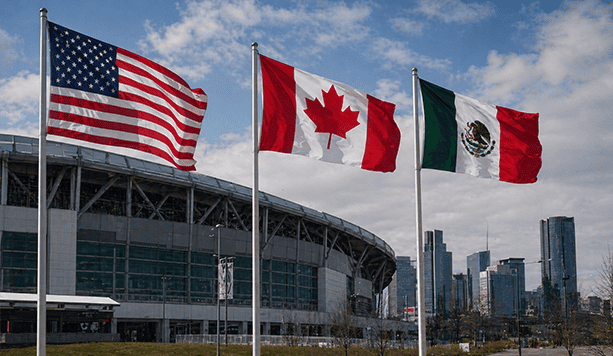
It’s an operational mistake to treat executive travel planning and security for the 2026 World Cup as a single event governed by a unified security logic.
The United States, Canada, and Mexico, each have distinct policing cultures, firearms rules, immigration enforcement models and thresholds for federal intervention.
For international travelers, this fragmentation has practical consequences. Legal exposure, operational constraints, and security assumptions can shift materially at each border. A delegation that moves smoothly through one jurisdiction may face additional screening, different role limitations, or stricter enforcement conditions in another.
That inconsistency is one of the defining operational realities of the 2026 World Cup.
United States: scale, fragmentation, and enforcement exposure
The United States will present the most resource-intensive and operationally complex security environment of the three host countries. Federal support reflects this, with the Federal Emergency Management Agency allocating $625 million across host cities.
However, Reuters reported in April 2026 that the prolonged Department of Homeland Security (DHS) shutdown has already disrupted planning and coordination, with DHS’s Christopher Tomney telling the Senate that furloughs and the loss of TSA expertise had hindered coordination with state and local partners.
This matters because U.S. security operations depend on a wide range of actors operating in parallel: federal agencies, state and municipal police, transit authorities, private contractors, immigration authorities, and venue teams. For a principal moving between airport, hotel, hospitality site, and stadium, the visible security posture may appear coordinated, while the authority structure underneath remains fragmented.
For international travelers, exposure also extends to the border. U.S. Customs and Border Protection officers have the authority to search phones, laptops, cameras, and other electronic devices during border inspection. For executives, family offices, journalists, and security teams, this creates exposure around contact lists, travel plans, internal reporting, and commercially sensitive material.
Together, these factors create a security environment where capability is high, but predictability is uneven—particularly at the points where authority, movement, and enforcement intersect. That contrasts with Canada, where authority is more centralized, but operational flexibility is more constrained.
Canada: centralized legitimacy and stricter role boundaries
Canada operates under a more centralized national security structure, with clearer jurisdictional boundaries between agencies.
The Royal Canadian Mounted Police will support World Cup operations alongside the Canada Border Services Agency and the Canadian Security Intelligence Service. Local police forces in cities such as Toronto and Vancouver will remain central, but federal coordination is more clearly defined than in the United States.
This clarity is reinforced by a political emphasis on sovereignty. Canadian authorities have demonstrated sensitivity to the optics of foreign law enforcement presence. In April 2026, Toronto city council moved to oppose any deployment of U.S. immigration authorities at World Cup events. Federal officials did not formally endorse the motion but reiterated that law enforcement within Canada remains under Canadian jurisdiction. The signal is clear: authority is controlled, and its boundaries are enforced.
Despite this, Canada presents its own set of security constraints for executives traveling to Canada for the World Cup, particularly at the point of entry.
Entry as a business visitor is possible for many event-related activities, often for up to six months, but only if individuals are not entering the Canadian labor market. That distinction is operationally significant. Support staff, including technical teams, assistants, media crews, or contracted personnel, may assume their roles fall under routine event participation. In practice, certain functions may trigger work-permit requirements, and misclassification can create delays or denial of entry.
Admissibility decisions can also intersect with political context. In April 2026, several officials from the Palestine Football Association were denied visas for a pre-World Cup event in Vancouver. Authorities cited standard eligibility criteria without commenting on individual cases. While not indicative of a systemic pattern, the episode illustrates how immigration frameworks can become sensitive in a high-visibility environment.
As for border-search powers, the Canada Boarder Services Agency (CBSA) states that examinations of personal digital devices are not routine but may occur when officers identify concerns related to admissibility or legal compliance. For most travelers, the probability is low. For executives and intelligence-sensitive personnel, the consequence of exposure is what matters.
Lastly, operational constraints extend further. Canada does not provide a permissive environment for imported armed protection. Foreign security teams and residents must comply with declaration requirements, and provincial licensing frameworks. Even where limited importation is legally possible, it does not guarantee the ability to operate in an armed capacity. In practice, this often requires a restructuring of protective coverage, including reliance on local partners or unarmed postures in certain contexts.
So while Canada offers consistency in governance, there is little to no flexibility in how roles are interpreted or executed in practice.
Mexico: visible force, restrictive law, and uneven operating environments
Mexico is likely to present the most visible security posture of the three host countries.
In March 2026, President Claudia Sheinbaum stated that up to 100,000 security personnel could be deployed during the tournament. The scale reflects a strategy focused on deterrence and control, as well as the need to insulate World Cup infrastructure from broader criminal dynamics.
However, the gap between secured zones and the spaces between them is where exposure emerges.
A heavily secure stadium or fan zone does not imply a uniformly secure urban environment. Movement between airports, hotels, training facilities, and venues will take place in cities where underlying risks like organized crime activity, vehicle theft, and route sensitivity, remain present if not constant.
Cities such as Guadalajara and Monterrey illustrate this dynamic. While event sites may be tightly controlled, surrounding areas require disciplined movement planning, particularly for high-profile individuals or structured delegations.
Legal constraints further shape the environment. Mexico is the most restrictive of the three countries with regards to weapons. Bringing firearms, ammunition, or related equipment into the country without explicit authorization from the Mexican government is a serious criminal offense. Even minor violations, such as undeclared ammunition, can result in significant legal consequences. This creates immediate limitations for foreign security teams accustomed to operating under different frameworks.
Foreign close-protection teams cannot assume they can operate as they would in the United States or elsewhere. Armed protection requires Mexican licensing and regulatory approval. In most cases, this necessitates reliance on local providers, adjustments to protective posture, or a reconfiguration of how coverage is delivered.
What this means for international travelers to the World Cup
The differences between the three host countries translate directly into operational constraints.
In the United States, exposure centers on immigration enforcement dynamics and institutional fragmentation. In Canada, it lies in admissibility criteria, role classification, and strict control over enforcement authority. In Mexico, it is shaped by weapons law, regulatory constraints on private security, and the gap between secured event zones and broader urban risk.
These differences affect how teams are structured, how roles are defined, how protection is delivered, and how movement is planned.
The operational takeaway
For the 2026 World Cup, risk is defined by both threat level and by jurisdictional variation.
A workable approach requires addressing five questions in advance:
-
What changes at the border for principals, staff, and support personnel in each country
-
Which roles can be legally performed by each team member across jurisdictions
-
What data is carried on devices, and what exposure exists during inspection
-
Which movements depend on public authorities versus private coordination
-
Where routine interactions could trigger immigration, weapons, or admissibility consequences
For international travelers, that fragmentation is not a secondary consideration. It is part of the operating environment.
THE MAX MONTHLY
Get actionable intelligence, expert analysis, & key event updates straight to your inbox.
Sign up →