

Executive Summary
-
Jose Jeri, the former head of Congress, was sworn in as the interim President following the Congress-led impeachment of President Dina Boluarte.
-
Jeri has consolidated a new cabinet, comprising 18 portfolios, and led by Ernesto Alvarez, former head of the Constitutional Court, as Prime Minister.
-
Sustained anti-government sentiments primarily rooted in security grievances, coupled with Jeri’s unpopularity, to prompt recurring protests as well as elevated polarization leading to 2026 general elections.
-
Travel to Peru in the coming days and weeks can continue while maintaining heightened vigilance given potential for localized instances of unrest or disruptions during anticipated anti-government protests.
Current Situation
-
On October 10, President Dina Boluarte was impeached by the Congress on the grounds of “permanent moral incapacity” with 124 votes in favor and zero votes against the motion, concluding a presidential tenure that began in December 2022.
-
Following this, Jose Jeri, the head of Congress, was sworn in as the interim President. Jeri is a member of the centrist to centrist-right Somos Peru (SP) party.
-
As interim President, Jeri is scheduled to serve out Boluarte’s remaining presidential term until July 28, 2026. General elections in Peru are slated for April 12, 2026.
-
On October 14, Jeri swore in 19 members of his new cabinet, including the ministers of economy, interior, and foreign affairs. The new cabinet will be led by Ernesto Alvarez, former head of the Constitutional Court and a former member of the conservative Partido Popular Cristiano (PPC), as Prime Minister.
-
Meanwhile, Jeri imposed a 30-day State of Emergency (SoE) in metropolitan Lima and Callao, effective from 00:00 (local time) on October 22 amid recurring protests and associated unrest to denounce Jeri’s presidency and condemn the allegedly violent police actions against anti-government protesters on October 15, which had resulted in the death of one individual in Lima.
Assessments & Forecast
Boluarte’s impeachment reflects structural deficiencies in fragmented politics, political opportunism ahead of 2026 general elections
-
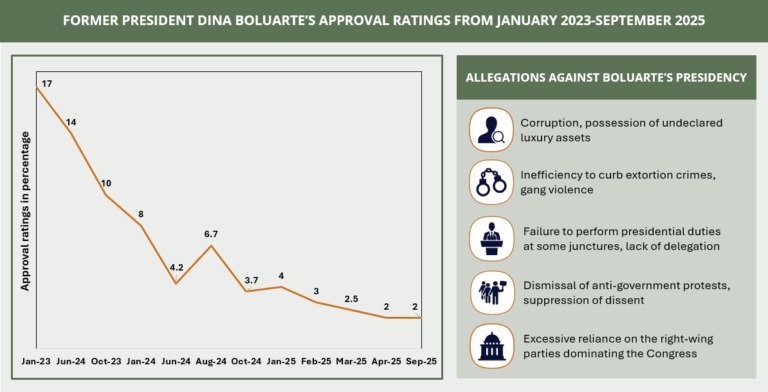
Dina Boluarte’s exit from the Presidency came amid overwhelming unpopularity in the country, with reports indicating that she left office with an approval rating between two to three percent, including zero percent from young people. This stemmed from accusations ranging from inefficiency in curbing rising insecurity from extortions and gang violence, neglecting political duties for foreign travel, corruption, failure to declare luxury items in her assets, and repression of anti-government protests and dissenting voices. Notably, Boluarte’s predecessor, former President Pedro Castillo, was also ousted in a Congress-led impeachment in December 2022, after he attempted to dissolve the Congress in what was denounced as a self-coup to weaken constitutional order. The deep-rooted structural instability of Peru’s political system is reflected in the fact that, over the past 10 years, the country has had eight presidents, most of whom resigned or were impeached over corruption allegations, inefficiency, or in response to anti-government protests.
-
Boluarte was also the sixth consecutive president to fail to complete a full term in office, a pattern that is likely to erode public confidence in the efficiency and value of electoral participation. That being said, in Boluarte’s case, it is largely evident that her presidency was fragile right from the outset. She assumed office on December 7, 2022, without a direct electoral mandate following Castillo’s impeachment, to complete the remainder of his term. This triggered widespread anti-government protests led by grassroots movements, social organizations, and indigenous communities demanding fresh elections. Castillo’s supporters also denounced Boluarte as a ‘traitor’ for accepting the presidency after serving as his vice president. In response, her administration declared a nationwide state of emergency on December 14, 2022. This led security forces to use force to suppress the demonstrations, with regions such as Puno, Ayacucho, Apurimac, Arequipa, Cusco, Junin, La Libertad, Huancavelica, Lima, and San Martin reporting the killing of protesters in police shootings between December 2022 and early 2023.
-
Further compounding sustained public dissatisfaction with her presidency, Boluarte lacked an organized political base. She governed as an independent after being expelled from the left-wing Peru Libre party in January 2022 due to ideological disagreements. Since then, her administration has relied heavily on an informal and fragile alliance with right-wing and centrist parties in Congress to maintain political support and advance legislative initiatives. This shift in alignment, from a leftist party to a right-wing base, may have been a strategic move, given the latter’s dominance in Congress. A similar pattern was observed in her predecessor, Castillo, who also distanced himself from Peru Libre in June 2022 to govern as an independent, and in alignment with the right-wing dominated Congress.
-
Peru’s Congress is widely regarded as wielding significant authority over the executive branch, having exhibited precedence of successful impeachments with overwhelming majorities. Moreover, Peru’s fragmented party system, characterized by multiple political parties, further contributes to political instability, as frequent shifts in allegiance reflect a broader disregard for ideological consistency. Consequently, presidents are often forced to rely on personal charisma to build loyalty within Congress, making them vulnerable to removal if these fragile alliances do not sustain. In this context, Boluarte’s dependence on the currently right-wing-dominated Congress significantly exposed her to constant political risk and realignments. This was reflected when the latest impeachment motion garnered zero opposition in Congress. The fact that Boluarte’s former allies ultimately supported her impeachment, after having previously thwarted eight impeachment motions throughout her presidency, underscores the volatility of her legislative backing. Moreover, the use of the “permanent moral incapacity” provision for Boluarte’s removal reinforces the extent to which Congress can leverage legal mechanisms for potentially political purposes. Originally intended as a safeguard for exceptional cases of presidential misconduct or mental incapacity, the clause remains undefined in the Constitution. However, this ambiguity has enabled Congress to apply it to behaviors perceived as unethical, corrupt, or politically objectionable. As a result, the provision has increasingly been highlighted as a potentially political instrument used by majority parties to remove presidents they oppose, with notable precedents in 2018, 2020, 2022, and now in 2025.
-
The latest congressional reversal of support for Boluarte, just six months before the general election on April 12, 2026, suggests a calculated effort by political parties to distance themselves from a deeply unpopular presidency and mitigate potential electoral backlash. This was likely prompted by the growing intensity of public dissent, evidenced by multiple strikes and protests across key sectors, including healthcare and transportation, over recent months. This also includes youth-led movements, particularly the emergence of protests in Lima in September, inspired by the global wave of “Generation Z” anti-government demonstrations. These actions reflected widespread and growing dissatisfaction with the Boluarte government’s perceived inability to address longstanding structural issues in labor rights, public services, crime rates, corruption, and social inequity. Moreover, the convergence of these grievances has likely contributed to a prevailing climate of anti-government and anti-establishment sentiment, particularly among the working class. Accordingly, these factors appear to have influenced political maneuvering and cross-party unity in favor of impeachment. Moreover, this allows Boluarte’s former allies to frame their support for the impeachment as an institutional response to public grievances, reinforcing the assessment that the move was strategically timed to minimize electoral costs.
Anti-government protests expected to recur amid current lack of public confidence in Jeri’s ability to manage interim government
-
While Boluarte’s impeachment was reportedly welcomed by the general public, including the protesting groups, Jose Jeri’s swearing-in appeared to partly reverse these sentiments. This was evident in the anti-government demonstrations called between October 12-15 by these groups with the demand “que se vayan todos,” or “throw them all out,” reportedly directed at both Jeri and the right-wing majority that dominates the Congress. This can be attributed to Jeri’s controversial political background, marked by reported accusations of sexual assault in a now-shelved case. Moreover, local media outlets have previously accused Jeri of soliciting payments from businesses in exchange for political favors. Therefore, Jeri’s appointment to the highest office in the country seems to have deepened concerns that his interim presidency may serve to protect the interests of influential business sectors, including mining corporations and major banks, to the detriment of the working class.
-
Moreover, Jeri’s presidency, like Boluarte’s, comes without an electoral mandate, a factor which could invite similar public perceptions of limited democratic legitimacy. Additionally, Jeri has had relatively short political experience compared to veterans in Congress, which is anticipated to raise concerns over his capacity to stabilize the political landscape. He joined the SP party in 2013 and twice ran unsuccessfully for municipal office in Lima. In 2021, he failed to win a congressional seat but ended up being assigned the seat of another party member who was disqualified from taking public office. He rose to national prominence following his accusations, as well as becoming the head of Congress in July.
-
Given this mixed political trajectory, public concerns over his governance capacity are expected to sustain, exacerbated by reports indicating that Jeri is also vulnerable to being influenced by seasoned congressional members. These concerns are likely fueled by Jeri’s right-wing alignment, making him more likely to follow the views of the right-wing majority in Congress. Public perceptions that Congress wields disproportionate political influence further amplify this risk, especially given that Jeri served as congressional president at the time of his appointment. If this perception intensifies among the public, it could be perceived as a continuation of the pattern and reliance on these factions recorded during Boluarte’s unpopular presidency.
-
FORECAST: Instead of reassuring the public, the latest government change is likely to deepen perceptions of political self-interest and transactional governance driven by the right-wing. Given this, anti-government demonstrations are expected to recur, particularly in Lima. In central Lima, demonstrations remain likely around symbolic and strategic locations such as the Congreso de la Republica, the Palacio de Gobierno, and Ministerio Publico. Further, public squares and major thoroughfares in downtown Lima are expected to serve as natural gathering points for large crowds, including historically popular protest locations like Plaza Dos de Mayo and Plaza San Martin.
-
Moreover, Avenida Abancay, a major artery connecting central Lima to surrounding districts, and other commercial corridors like Avenida Nicolas de Pierola and Jiron de la Union may also serve as protest locations. Civil society groups, transport and workers’ unions, student organizations, and youth activists under the “Generation Z” banner are likely to continue mobilization in the coming weeks and months. These groups are expected to apply sustained pressure on the interim government to respond to a broad set of demands, including institutional reforms, enhanced accountability, improvements to the security landscape, and resolution of labor-related grievances.
-
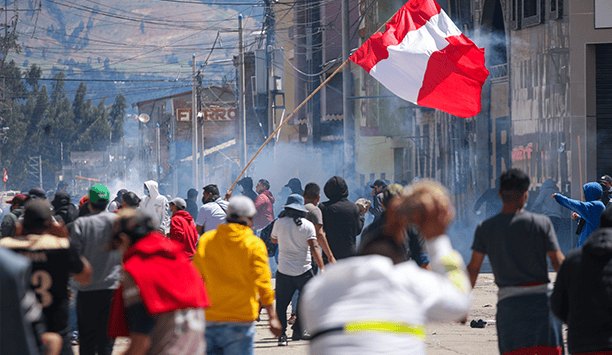
Although demonstrations are expected to be peaceful, the risk of unrest remains elevated, particularly in Lima. Isolated incidents of vandalism, arson, road blockades, and clashes with security forces cannot be ruled out, particularly if police response is perceived as excessive. For instance, Generation Z demonstrations in Lima on September 20-21 and 27-28, and on October 4, reportedly commenced peacefully but escalated with protesters throwing stones and incendiary devices at police and physically clashing with them. Authorities responded with tear gas, rubber pellets, and arrests. Similarly, protests in Lima on October 15 recorded the death of one protester, and injuries to at least 20 demonstrators and over 80 police officers amid unrest around the Congreso.
-
This precedent suggests that the Jeri-led interim government is likely to exercise greater caution in its handling of public demonstrations. Given Jeri’s lack of a direct electoral mandate, preserving legitimacy ahead of the April 2026 elections is likely to be a key priority. As such, his administration is expected to focus on de-escalation and measured crowd control to avoid drawing comparisons to the unpopular dismissive responses of the Boluarte administration in the immediate aftermath of assuming office. Moreover, the example of former interim president Manuel Merino, who resigned just five days into office in November 2020, amid massive public and congressional pressure following two protest-related deaths due to a violent police crackdown, is likely to serve as a cautionary example for Jeri.
-
That being said, as recorded in the recent demonstrations, security forces are likely to respond with crowd-control measures in the event of unrest or disruptions during anticipated anti-government demonstrations. Moreover, allegations of excessive force, which remain heightened in protest rhetoric following the death of a demonstrator due to a police shooting on October 15, will sustain calls for Jeri’s resignation from protest groups. However, congressional pressure aligning with such demands may remain limited in scope, unless the authorities’ response is recorded as disproportionately forceful or unjust.
-
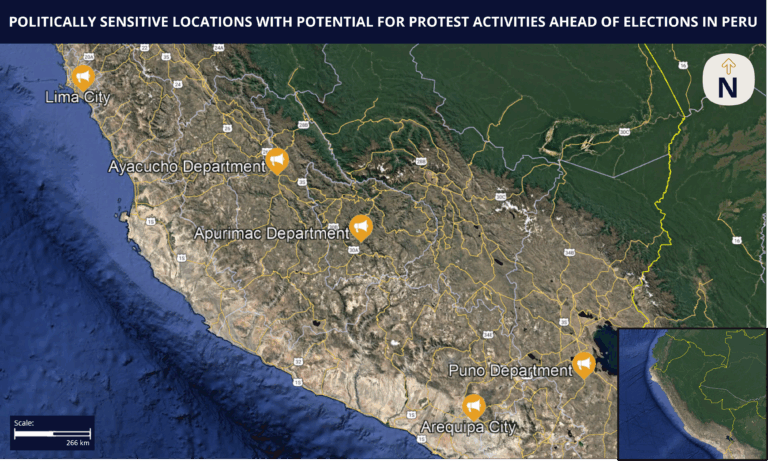
Moreover, in the coming months, this protest landscape is likely to converge with an increasingly volatile political climate, fueled by heightened campaign rhetoric, online disinformation, and polarizing narratives. Political rallies in support of candidates may be met with counter-demonstrations organized by anti-establishment groups, unions, or civil society organizations pressing for broader systemic reforms. The possibility of localized clashes between opposing groups, especially in regions with strong protest histories and civic mobilization, cannot be ruled out. In this context, politically sensitive areas include the Southern Andean departments of Ayacucho, Apurimac, and Puno, as well as major urban centers like Arequipa and Lima. Given this anticipated intensification of political sentiments and potential for overlapping demonstrations, the risk of small-scale confrontations, road blockades, or disruptions near campaign events is likely to increase in the months leading up to the elections.
New cabinet, SoE imposition indicates Jeri’s security-focused actions, likely strategic attempt to differentiate from Boluarte
-
Jeri’s early actions as interim president suggests an attempt to center his governance around security concerns. In his first address after swearing in, he emphasized public safety, declaring that “the main enemy is out on the streets. Criminal gangs, criminal organizations, they are our enemies today.” This was reinforced by Jeri leading coordinated raids on prisons housing gang leaders nationwide on October 11, including in Lima’s Ancon 1 prison and Lurigancho prison, the Challapalca maximum-security prison in the Andes, and the El Milagro prison in La Libertad region, and in the Castro Castro prison in Juan de Lurigancho district on October 13. These raids reportedly led to the confiscation of weapons, cash, and drugs. Further, Jeri also met with representatives of the armed forces and police as one of his first agendas, followed by the October 22 enactment of the SoE. These measures reflect Jeri’s strategic effort to address public anxiety over insecurity and signal an attempt to reinforce his leadership credentials by prioritizing the most immediate cause of protests in recent months.
-
Separately, Jeri is also expected to be more receptive to addressing concerns beyond insecurity. According to October 14 reports, following a meeting with the Mayor of Pataz, Aldo Marinos, the interim president agreed to engage in dialogue with local leaders, unions, organized civil society, and Generation Z activists to discuss their grievances. However, the potential for such talks remains uncertain, particularly as the ongoing SoE risks being perceived as a continuation of security tactics used by Boluarte. Moreover, the timing of the latest SoE and likely curfews amid a volatile protest environment may be seen by protesters as an attempt to suppress dissent, potentially undermining Jeri’s efforts to project authority if the measures fail to yield tangible security improvements.
-
That said, Jeri’s cautious stance in avoiding outright condemnation of the anti-government protests, while reportedly attributing the October 15 violence to “criminal infiltrators,” contrasts with Boluarte’s outright dismissal of similar demonstrations in September, underscoring Jeri’s likely intent to distance himself from his predecessor’s approach. Moreover, Jeri’s attempt to build political and public legitimacy separate from Boluarte’s image is also indicated by his decision to form a new cabinet. Following Boluarte’s impeachment, the Congress had rejected a motion of censure against Prime Minister Eduardo Arana Ysa, meaning that the Boluarte cabinet carried over into the presidency of Jeri. Instead, Jeri chose to consolidate a new ministerial team, which was announced on October 14.
-
FORECAST: Amid heightened anti-government sentiment and a growing need to project efficient leadership through decisive action, Jeri’s cabinet is expected to introduce legislation aimed at strengthening security measures and addressing broader social grievances in the weeks ahead. However, the current appointees, including Prime Minister Ernesto Alvarez, will position the cabinet as strongly right leaning. Moreover, Alvarez had reportedly denounced the anti-government protests in September as an attempt by radical elements to subvert democracy. At the same time, Jeri has framed his right-leaning cabinet as a “broad-based government,” citing the inclusion of individuals from varying backgrounds from career diplomats, economists, and retired security officers.
-
Nonetheless, this conservative composition appears to be a strategic move to maintain support in the right-wing dominated Congress and navigate Peru’s fragmented political landscape until end of term in July 2026. That said, these factors will likely complicate the interim administration’s efforts to build public trust, including demonstrating the cabinet’s ability to operate independently without any influence from congressional right-wing factions. Moreover, since earlier SoEs in Lima between March and July recorded limited impact, the current SoE is also unlikely to immediately ease anti-government sentiments unless it delivers tangible results in reducing extortion-related violence.
Political polarization to heighten ahead of April 2026, with high likelihood for fragmented legislature post-election
-
With just six months remaining until the 2026 general elections, political rhetoric and polarization are expected to intensify over the coming months. Similar to Jeri-led interim government’s anticipated agenda, campaign narratives across the political spectrum are expected to focus heavily on issues of insecurity and other social grievances. However, given that these have been long-standing issues spanning previous administrations, anti-government and anti-establishment sentiments are expected to sustain in the electorate. The political landscape is also complicated by reports indicating that a record 34 political parties are set to compete independently in the elections, while 11 additional parties have formed four alliances, resulting in at least 38 presidential candidates on the ballot.
-
This exceeds the general norm of 15 to 20 candidates during general elections, signaling a high likelihood of a resultant fragmented legislature, which may lack clearly defined political leaders and could be populated by parties with limited representation. Such a result stands to complicate efforts to form stable majorities needed to pass legislation. Consequently, future presidents, even if elected with a clear plurality, will likely face considerable difficulty forming stable governing alliances and may be incentivized to avoid antagonizing Congress. This would, in turn, potentially reinforce legislative dominance and weaken executive authority, as recorded with Boluarte’s administration, elevating the potential for political gridlock to continue.
-
The risk for this is potentially particularly elevated in 2026. In 2021, Peru voted for a unicameral Congress that was divided among 10 political blocs. At the time, only three parties won over 10 percent of the vote, leading to legislative gridlock, frequent cabinet turnovers, and growing public disillusionment with democratic institutions. In the upcoming elections in 2026, Peru will vote members for a bicameral Congress, that is, for a Chamber of Deputies and a Senate, suggesting that the potential for political representative fragmentation could extend to both houses, further hindering stable coalition-building. Further, while a bicameral system would introduce risks of legislative gridlock, it also carries the potential to provide partial institutional checks by dispersing the currently concentrated power of Congress and increasing deliberations. This underscores the significance of the upcoming elections as more seats will potentially determine the balance of power post-elections and shape the prospects of the incoming government.
-
Separately, privately conducted polls on voting intentions reflect broader uncertainty in the population. As of September 25, Lima Mayor and conservative Renovacion Popular (RP) candidate Rafael Lopez Aliaga leads with only 10 percent of voting intentions. He is followed by Keiko Fujimori, leader of the right-wing Fuerza Popular (FP), and Mario Vizcarra, candidate for big-tent Peru Primero, each recording seven percent support. All other potential candidates for president in 2026 poll below five percent. However, the numbers recorded by the three leading candidates may be more suggestive of their recognition due to their political tenure than by voter confidence in their leadership. This is also based on separate, privately conducted polls indicating that 37 percent of voters plan to cast blank votes, while 60 percent remain undecided. Additionally, under a 2021 law barring consecutive presidential terms, interim President Jeri is ineligible to run in 2026, making it likely he will focus on short-term governance through July 2026 rather than pursuing long-term political ambitions.
-

-
FORECAST: For the near term, public perceptions of government stability or effectiveness are unlikely to change substantially following Boluarte’s impeachment and Jeri’s inauguration, unless the interim government demonstrates tangible progress on security and governance. This is also based on unverified reports indicating that, as of writing, Jeri’s approval ratings continue to range between six and 10 percent, only slightly higher than Boluarte’s at the time of her exit, indicating a minimal surge in confidence following the administrative shift. As the election period approaches, voter skepticism toward both the interim administration and established political elites is likely to deepen, reinforcing anti-establishment narratives. Although gang-led political violence has not historically been a widespread concern in Peru, the continued rise in extortion and gang activity raises the risk of isolated acts of intimidation targeting candidates. This may include sporadic shootings or threats directed at local party offices, campaign convoys, or election-related infrastructure, particularly in areas where gangs are seeking to assert territorial or economic control. This includes regions along the northern coastal areas, like the La Libertad region, southern coastal areas, as well as peripheral and urban areas within Lima province.
Recommendations
Those operating or residing in Peru on October 14 and over the coming days are advised to maintain heightened vigilance around any protest locations related to anti-government demonstrations and associated unrest.