

Executive Summary
-
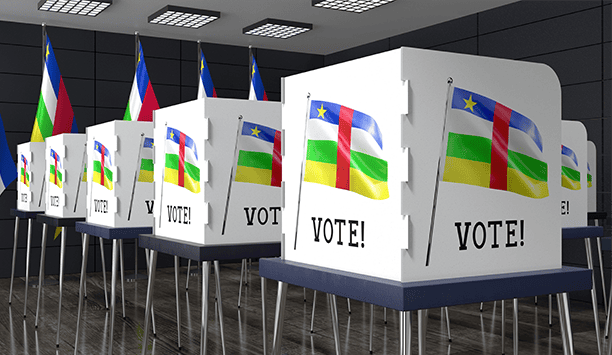
CAR will hold general elections on December 28. Unlike the 2020 elections, these polls will take place amid an improved security landscape given a decline in rebel activity. That said, other factors of insecurity persist, primarily high levels of crime, and these would be the key security concerns during the electoral period.
-
The polls come as President Faustin-Archange Touadera, in power since 2016, has consolidated his political power, enjoying significant support from Russia. He is also expected to benefit from opposition weakness and will therefore achieve a landslide victory in the first round.
-
Given the relatively improved security situation and the opposition’s weaknesses, election day will likely transpire without major incidents. The opposition is also unlikely to mobilize significant protests after results are announced, and the political landscape is anticipated to stabilize quickly.
-
Those operating or residing in CAR over the coming weeks are advised to maintain heightened vigilance and avoid the vicinity of all political gatherings and election-related facilities due to the political tensions and potential for unrest.
Current Situation
-
CAR will hold general elections on December 28 under a two-round majority system for the presidency, while National Assembly members are elected in single-member constituencies that require run-off votes when no candidate surpasses 50 percent. The National Electoral Authority (ANE) announced that there are over 2.3 million eligible voters.
-
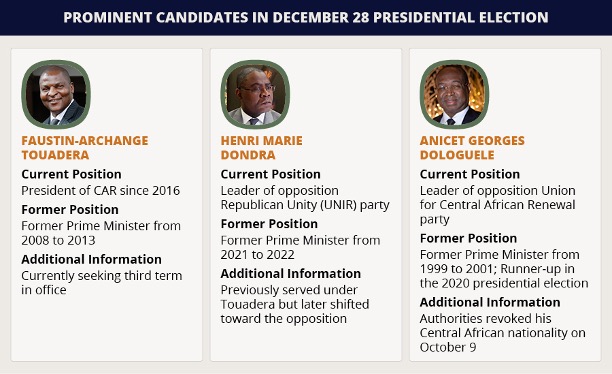
The Constitutional Court approved seven presidential candidates on November 14, including President Faustin-Archange Touadera of the ruling United Hearts Movement (MCU) party, seeking a third term in office. The two most prominent candidates opposing him are Anicet-Georges Dologuele of the opposition Union for Central African Renewal (URCA) party and former prime minister Henri-Marie Dondra.
-
The opposition Republican Bloc for the Defense of the Constitution (BRDC) declared a boycott of the elections, citing institutional bias. This came after attempts to open negotiations between the BRDC and the government collapsed in September after the government refused to reshuffle the ANE or change the electoral schedule.
-
Reports from October 10-11 indicate that a day after the URCA party named Dologuele as its presidential candidate, the authorities announced that he had lost his Central African nationality because he had held French citizenship until August. Dologuele filed his candidacy on October 12, leading the BRDC platform to expel him.
-
On November 19, the government and the Patriotic Movement for the CAR (MPC) rebel group signed a peace deal in N’Djamena, Chad. The deal includes a complete ceasefire, the release of prisoners and amnesty for repentant fighters, and the group’s engagement in disarmament and demobilization processes.
-
Reports from October 24 indicate that the UN Multidimensional Integrated Stabilization Mission in the CAR (MINUSCA) spokesperson announced a possible imminent reduction of military and civilian personnel. She claimed that this is due to a 15 percent budget cut for the peacekeeping mission. In mid-November, MINUSCA’s mandate was renewed for another year by the UN Security Council.
-
At the time of writing, there were no reported reductions in peacekeepers’ numbers in CAR. MINUSCA officials have repeatedly expressed their commitment to assist in the organization of the elections, in accordance with the force’s mandate.
Assessments & Forecast
Security improvements, peace deals with rebel groups limit potential security threats amid elections, though other factors of insecurity persist, including crime
-
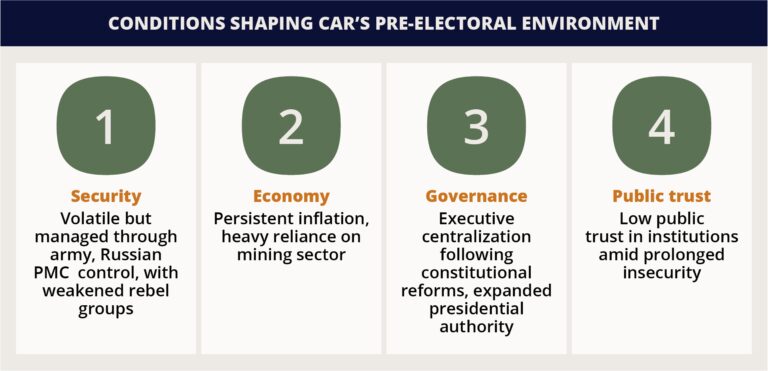
The security environment ahead of the upcoming elections is shaped by developments dating back to the formation of the Coalition of Patriots for Change (CPC) rebel platform in December 2020, just before the previous elections. The coalition, created by former president Francois Bozize who was barred from running in the 2020 election, brought together six of the country’s prominent armed groups, including the Return, Reclamation and Rehabilitation (3R), the Union for Peace in the CAR (UPC), the Popular Front for the Rebirth of the CAR (FPRC), and the Patriotic Movement for the CAR (MPC). CPC fighters launched coordinated attacks across multiple prefectures, with each group operating within its traditional strongholds, and occupied vast territory. The rebels reportedly prevented voting in over 800 polling stations out of the 5,408 nationwide. The CPC even attacked Bangui in mid-January 2021, but were repelled by UN peacekeepers, Rwandan soldiers deployed to secure the elections, and Russian private military contractor (PMC) personnel.
-
This was a key turning point as Russian-led operations against rebel groups intensified and gradually covered the entire national territory. Over the following years, these operations have significantly eroded the capabilities of major armed groups, with the Russians acting with brutality, effectively discouraging locals from supporting these groups. The operations also took advantage of the important factor that the CPC was a loose umbrella body that coordinated the actions of different groups, rather than a platform that promoted close cooperation or integration of the groups. Therefore, amid the intense security operations, the various armed groups were quickly dislodged from the more urban areas they were able to capture in December 2020 and returned to their traditional hideouts in densely forested areas. The operations also led to a gradual reduction in the frequency of rebel attacks, and most groups appear to have begun prioritizing actions that would carry financial benefits, such as extorting money from road travelers or seeking to dominate remote areas where mining sites are located, while avoiding any attempt to control populated areas. Over time, the various groups’ ability to recruit new members or gain the cooperation of local communities significantly eroded, mostly due to the effectiveness of the Russian PMCs’ approach, which was implemented by their Central African partners as well.
-
These conditions have likely pushed rebel leaders into accepting the path of negotiations with the government. On April 19, the leaders of 3R and UPC signed a ceasefire agreement in Chad, expressing their willingness to rejoin the 2019 peace accord and participate in the disarmament, demobilization, reintegration, and reinsertion (DDRR) process. This was highly notable considering that these two groups have been the most active, and their members still perpetrated intermittent attacks at the time. The MPC also signed a peace deal with the government in November, although this was significantly less notable given that the group has been effectively inactive since November 2023. Although previous agreements, most notably the Khartoum peace accords from 2019, have failed to produce sustained calm, the recent deals come within a different context of armed groups being extremely weak and almost inactive, whereas previous agreements occurred when rebels were routinely conducting attacks. In this context, the peace deals with rebel groups ahead of the elections likely stem from the government’s intentions to ensure that the 2020 scenario does not repeat itself, while also gaining credibility by presenting President Touadera as pursuing peaceful dialogue.
-
Despite the significant gains and the peace deals, broader security conditions remain fragile. This primarily includes the persistently high levels of crime nationwide, in remote rural areas as well as in larger towns, and even in Bangui. This includes criminal attacks on road travelers, businesses, farming communities, mining areas, or herders with the intention of extorting money or stealing valuables, with assailants typically using firearms. These incidents have been particularly more prominent in Vakaga Prefecture in the northeast due to spillover from the conflict in Sudan through the porous Sudan-CAR border, though crime affects the entire country. Intermittent intercommunal tensions are another factor of insecurity. Furthermore, the Russian PMCs and to some extent the Central African military present their own threat to security given that they mete out extrajudicial violence toward civilians to serve their own aims.
-
FORECAST: Given these circumstances, the main security concern surrounding the polls, unlike the 2020 electoral period, would be related to crime rather than rebel activity. The high levels of crime could serve to deter individuals from going to the polling stations, particularly outside major urban areas, due to the fear of being attacked. Criminals could also attack convoys carrying electoral materials due to perceptions that these convoys would carry food, medicine, or valuable goods. MINUSCA, despite the proposed financial cuts, will likely remain committed to its promise to support the organization of the elections and secure convoys as well as polling stations or tallying centers. Russian PMCs are also likely to support the Central African security forces and assist in maintaining security and protecting polling stations, particularly in Bangui.
President Touadera’s institutional dominance, support he enjoys from Russia, opposition’s fragmentation, to facilitate his re-election
-
The security gains have also strengthened President Touadera’s political position heading into the elections. The government has leveraged the decline in rebel activity and recent peace deals to present Touadera as the guarantor of stability, which corresponds with the narrative that brought him to power in 2016, when he promised to engage with rebel groups to end the country’s civil war that began in 2013. This comes as Touadera has consolidated his political prominence in recent years, primarily thanks to his ties with Russia and the Russian PMCs’ perception of him as a preferred and convenient partner. This is why they protected him when the CPC rebels launched their offensives during the 2020 electoral period, and this is also why they supported his initiative to amend the constitution in 2023 to remove presidential term limits and facilitate his continued hold on power. Touadera has also leveraged the support he receives from Moscow to ensure he has complete influence over the judicial system and the electoral bodies.
-
Touadera has used his growing political strength, with the support of Russia, to repress any significant opposition voices through intimidation tactics that include arrests, the prevention of travel abroad, and other measures. The revocation of the Central African nationality of prominent opposition figure and runner-up in the 2020 polls, Anicet-George Dologuele, was an indication of how Touadera is able to use his influence over state institutions to prevent any significant challenge to his re-election ambitions. The courts’ eventual decision to include Dologuele and Henri-Marie Dondra on the ballot was likely taken in coordination with Touadera or his close circle, and intended to create the appearance of inclusiveness. The ruling MCU party maintains extensive reach across public institutions, state media, and patronage networks, and this ensures that the party can maintain its dominance and that there is no real challenge to Touadera’s electoral bid.
-
Touadera also benefits from the inherent weaknesses within the opposition camp. The BRDC’s decision to boycott the election removes one of the few prominent opposition platforms capable of mobilizing support across multiple prefectures. The expulsion of Dologuele by BRDC after he insisted on filing his candidacy despite the platform announcing a boycott further highlights internal divisions within the opposition camp. The campaign of Henri-Marie Dondra, who served as prime minister under Touadera, also faces various constraints, characterized by limited grassroots structures and reduced visibility related to his decision to run as an independent candidate. These factors underscore the absence of a cohesive opposition strategy. With no unified platform, limited organizational capacity, and restricted access to logistics and media resources, the opposition candidates are unlikely to mount an effective electoral campaign. Furthermore, their presence on the ballot only divides opposition votes, and the fact that there are various voices within the opposition camp also undermines its ability to mobilize crowds for potential protests.
-
FORECAST: Election day itself will likely transpire without major disruption, with a bolstered security presence around polling stations. Precedent suggests that delays related to logistical challenges and poor infrastructure are expected, particularly in remote areas. The somewhat improved security landscape can lead to a slight increase in voter participation as compared to 2020, when it was around 35 percent, though such an increase will likely be primarily viewed in areas considered as pro-Touadera or where the government can coordinate the mobilization of voters, such as Bangui. In more remote areas, general factors of insecurity could deter participation.
-
FORECAST: Given these conditions, Touadera is expected to record a landslide victory and secure re-election in the first round, with the presence of security forces and Russian PMCs around polling stations also possibly intended to ensure favorable outcomes for Touadera. The opposition is likely to challenge the legitimacy of Touadera’s expected win, citing perceived institutional bias as well as concerns regarding voter participation. Given Touadera’s complete dominance over the judiciary, any appeals would be dismissed. Furthermore, considering the opposition’s weaknesses and the expected bolstered security measures, the potential for them to effectively mobilize supporters to protest against the election results is extremely low. Therefore, while opposition frustrations will be high, the political landscape is likely to stabilize within a short period after Touadera’s victory is confirmed.
Recommendations
Those operating or residing in CAR over the coming weeks are advised to maintain heightened vigilance and avoid the vicinity of all political gatherings and election-related facilities due to the political tensions and the potential for unrest.